

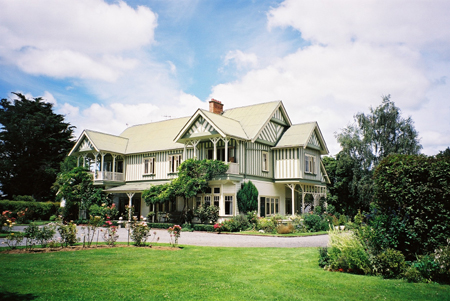
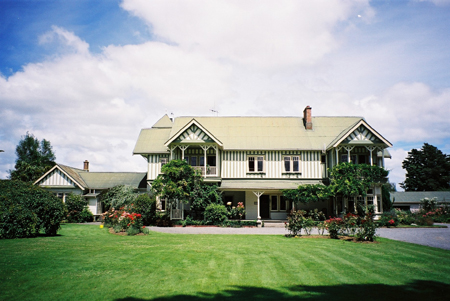
The homestead was built by James McChesney of Marton and designed in the Tudor style favoured by Natusch and fashionable in the early decades of the 20th century. The building's exterior features the half-timbering typical of the style. Inside are rimu floors, walls, doors and panelled ceilings. Maungaraupi remained in the family until the 1980s, first as a family home and later as a guesthouse. Today it is a private dwelling and function centre with accommodation.
Maungaraupi is a fine example of the work of one of New Zealand's better-known domestic architects, Charles Natusch. The homestead is noted for its fine workmanship and the detailing evident in the interior. It is historically significant for its links to the Swainson family and John Williams Marshall.
List Entry Information
Status
Listed
List Entry Status
Historic Place Category 1
Access
Private/No Public Access
List Number
4916
Date Entered
2nd July 1987
Date of Effect
2nd July 1987
City/District Council
Rangitīkei District
Region
Horizons (Manawatū-Whanganui) Region
Extent of List Entry
Extent includes the land described as Lot 1 DP 359562 (RT 295223), Wellington Land District, and the buildings known as Maungaraupi Homestead thereon.
Legal description
Lot 1 DP 359562 (RT 295223), Wellington Land District
Location Description
338a Leedstown Rd
Status
Listed
List Entry Status
Historic Place Category 1
Access
Private/No Public Access
List Number
4916
Date Entered
2nd July 1987
Date of Effect
2nd July 1987
City/District Council
Rangitīkei District
Region
Horizons (Manawatū-Whanganui) Region
Extent of List Entry
Extent includes the land described as Lot 1 DP 359562 (RT 295223), Wellington Land District, and the buildings known as Maungaraupi Homestead thereon.
Legal description
Lot 1 DP 359562 (RT 295223), Wellington Land District
Location Description
338a Leedstown Rd
Construction Professional
Name
Natusch, C.T. & Sons
Type
Architectural Partnership
Biography
Charles Tilleard Natusch (1859-1951) completed his architectural studies in England in 1882, after which he travelled in the United States and Canada. He returned to England in 1883 to become involved in the town planning and development of Southend-on-Sea. He immigrated to New Zealand in 1886 and after a short collaboration with Atkins & Clere, established a practice in Wellington as an architect and quantity surveyor. He then moved to Masterton, Pahiatua and finally to Napier, where he bought the architectural practice of Robert Lamb. From 1908 Natusch worked with his three sons, Aleck, Rene and Stanley. The firm received many domestic commissions from the farming community. Its well known houses include Bushy Park (Kai Iwi), Gwavas (Tikokino), Matapiro (Napier), Maungaraupi (Marton) and Wharerata (Massey University). Following several changes of name and three generations of Natusch architects, the family practice continues today as Natusch Partnership in Napier.
Construction Details
Start Year
1906
Type
Original Construction
Construction Materials
Concrete foundations and timber seasoned for two years. The interior is built of rimu. The floor and weatherboards are of matai and the verandahs and supports are of totara. The roof is corrugated iron.
Construction Professional
Name
Natusch, C.T. & Sons
Type
Architectural Partnership
Biography
Charles Tilleard Natusch (1859-1951) completed his architectural studies in England in 1882, after which he travelled in the United States and Canada. He returned to England in 1883 to become involved in the town planning and development of Southend-on-Sea. He immigrated to New Zealand in 1886 and after a short collaboration with Atkins & Clere, established a practice in Wellington as an architect and quantity surveyor. He then moved to Masterton, Pahiatua and finally to Napier, where he bought the architectural practice of Robert Lamb. From 1908 Natusch worked with his three sons, Aleck, Rene and Stanley. The firm received many domestic commissions from the farming community. Its well known houses include Bushy Park (Kai Iwi), Gwavas (Tikokino), Matapiro (Napier), Maungaraupi (Marton) and Wharerata (Massey University). Following several changes of name and three generations of Natusch architects, the family practice continues today as Natusch Partnership in Napier.
Construction Details
Start Year
1906
Type
Original Construction
Construction Materials
Concrete foundations and timber seasoned for two years. The interior is built of rimu. The floor and weatherboards are of matai and the verandahs and supports are of totara. The roof is corrugated iron.
Historical and Associated Iwi / Hapū / Whānau
Completion Date
11th October 2001
Report Written By
Helen McCracken
Information Sources
Alexander Turnbull Library
Alexander Turnbull Library, Wellington
Scholefield, 1940
G. H. Scholefield, A Dictionary of New Zealand Biography, Department of Internal Affairs, Wellington, 1940
Taihape Daily Times
Taihape Daily Times
Other Information
This place was identified as significant under previous legislation with different information requirements. It remains significant under the current legislation. There is opportunity under our legislation and policies to add to this information. Further information about this place may be available from the Central Regional Office of Heritage New Zealand Pouhere Taonga. Please note that entry on the New Zealand Heritage List/Rarangi Korero identifies only the heritage values of the property concerned, and should not be construed as advice on the state of the property, or as a comment of its soundness or safety, including in regard to earthquake risk, safety in the event of fire, or insanitary conditions.
Historical and Associated Iwi / Hapū / Whānau
Completion Date
11th October 2001
Report Written By
Helen McCracken
Information Sources
Alexander Turnbull Library
Alexander Turnbull Library, Wellington
Scholefield, 1940
G. H. Scholefield, A Dictionary of New Zealand Biography, Department of Internal Affairs, Wellington, 1940
Taihape Daily Times
Taihape Daily Times
Other Information
This place was identified as significant under previous legislation with different information requirements. It remains significant under the current legislation. There is opportunity under our legislation and policies to add to this information. Further information about this place may be available from the Central Regional Office of Heritage New Zealand Pouhere Taonga. Please note that entry on the New Zealand Heritage List/Rarangi Korero identifies only the heritage values of the property concerned, and should not be construed as advice on the state of the property, or as a comment of its soundness or safety, including in regard to earthquake risk, safety in the event of fire, or insanitary conditions.
Current Usages
Uses: Accommodation
Specific Usage: House
Former Usages
General Usage: Accommodation
Specific Usage: House
Current Usages
Uses: Accommodation
Specific Usage: House
Former Usages
General Usage: Accommodation
Specific Usage: House
Location
Stay up to date with Heritage this month
